


Turn Ambition Into Action: A Brain-Smart Guide to Goal Success

Every year, countless people set ambitious goals with genuine motivation and high hopes, only to find themselves frustrated, discouraged, and off track within weeks. If this sounds familiar, you’re not alone. Traditional advice often tells us to “work harder” or “push through,” but effort alone isn’t the problem. The real issue lies in how goals are set and how the brain responds to them.
Neuroscience offers valuable insight into why most goals fail and, more importantly, how to design goals your brain will actually support rather than resist.
Why Most Goals Don’t Stick
Research reveals a sobering reality: nearly half of people who set New Year goals expect to fail by February. Even more striking, only about 9% of individuals successfully achieve the goals they set for themselves each year. This means the vast majority are unknowingly entering the process already primed for disappointment.
This isn’t a motivation problem it’s a brain alignment problem. When goals feel overwhelming, vague, or unrealistic, the brain interprets them as a threat. And when that happens, self-sabotage isn’t a character flaw; it’s a biological response.
Step
One:
Learn
From
the
Past—Without
Judgment
Before setting new goals, it’s critical to reflect on what previously worked and what didn’t. This isn’t about dwelling on mistakes or labeling yourself as a failure. Instead, it’s a strategic review of habits, routines, and behaviors that either supported or blocked progress.
Ask yourself:
- Which daily habits moved me closer to my goals?
- Which behaviors drained my energy or distracted me?
- What patterns consistently worked against me?
By identifying these patterns, you give your brain data it can use to make better decisions moving forward. Reflection isn’t regression, it’s preparation.
Step Two: Set Goals Your Brain Can Handle
Your brain’s primary job is survival. The amygdala, the part of the brain responsible for detecting threat but it doesn’t distinguish between physical danger and overwhelming stress. When a goal feels too big, too vague, or too risky, your brain may trigger avoidance behaviors like procrastination, distraction, or self-doubt.
To prevent this, goals must feel achievable and safe. That doesn’t mean thinking small; it means thinking strategically.
If you have a large, ambitious goal, break it down into smaller, clearly defined milestones. When the brain sees a clear path forward, it stays engaged rather than defensive.
Step Three: Be Specific—The Brain Craves Clarity
Vague goals create confusion, and confusion leads to inaction. Statements like “I want to be healthier” or “I want more success” don’t give the brain enough information to act.
Specificity provides direction. Define:
- What exactly you want to achieve
- When you want to achieve it
- What daily or weekly actions support that outcome
Clear goals reduce cognitive load and make it easier for the brain to stay focused and motivated.
Step Four: Keep It Simple to Avoid Overwhelm
One of the fastest ways to derail progress is by setting too many goals at once. While ambition is admirable, cognitive overload shuts down follow-through.
Instead, identify your top three priorities. Focus on building habits that support those goals before adding more. Once momentum is established, expansion becomes easier and far less stressful.
Simplicity isn’t limiting; it’s enabling.
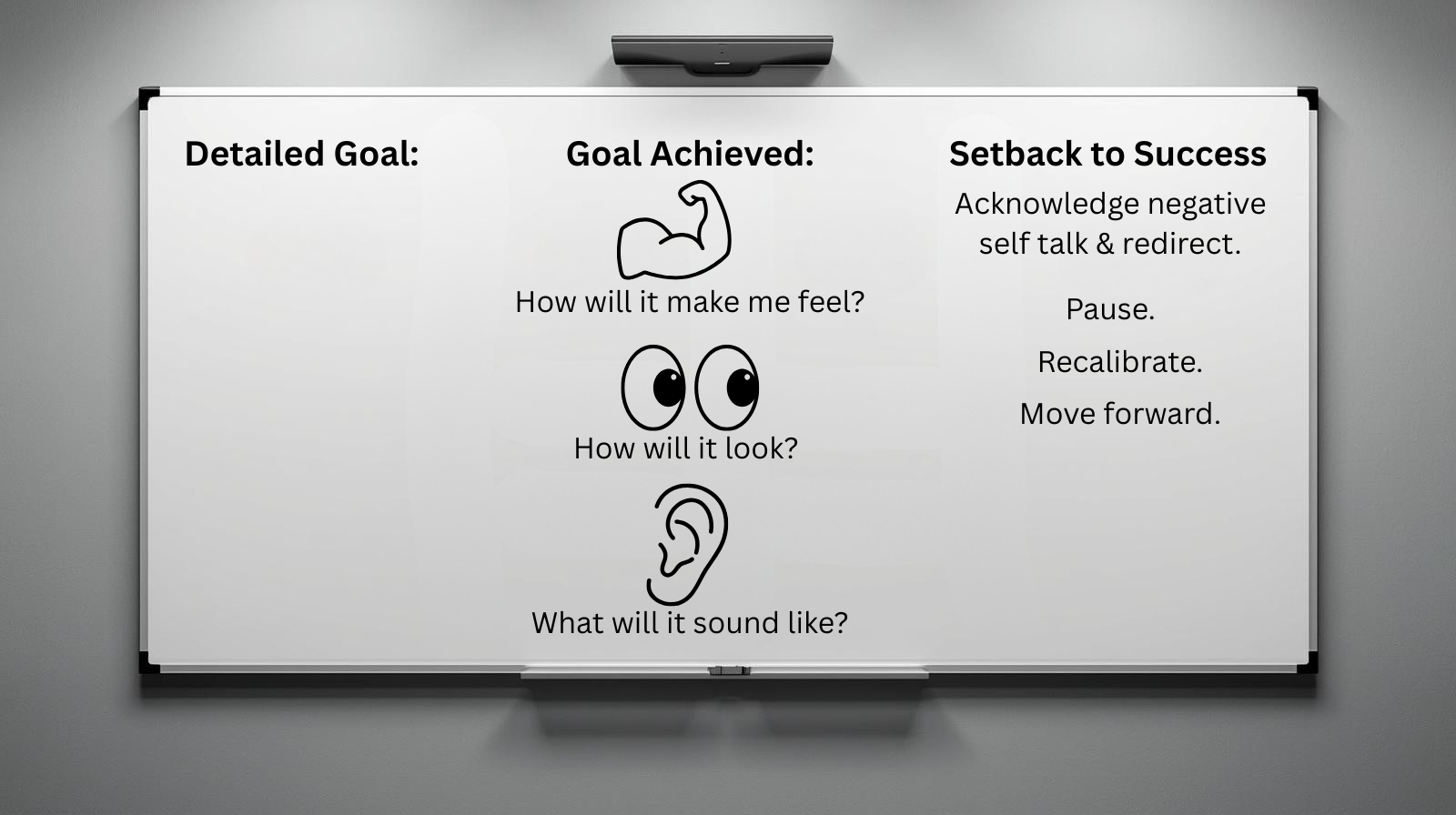
Step Five: Engage All the Senses
The brain learns and commits through sensory experience. Visualization alone isn’t enough, true engagement requires emotional and sensory involvement.
Ask yourself:
- What will achieving this goal feel like?
- What will it look like in my daily life?
- What sounds, routines, or environments will be different?
Use action boards or vision boards not just to see your goals, but to feel them. When the brain emotionally connects to an outcome, motivation becomes more sustainable.
Step Six: Manage Negative Self-Talk Instead of Fighting It
No journey is perfect. Setbacks happen, and negative thoughts will surface. The key isn’t suppressing them; suppression often makes them louder but acknowledge and redirect those negative thoughts.
When progress stalls, pause and reset:
- Take a few slow breaths
- Acknowledge what didn’t work
- Recommit from the current moment forward
Progress doesn’t require perfection; it requires recovery.
Step Seven: Keep Goals Visually Fresh
The brain quickly adapts to static environments. If visual reminders stay in one place too long, they fade into the background.
Move action boards, notes, or reminders regularly or schedule time each week to intentionally revisit them. This keeps goals mentally “visible” and reinforces emotional connection.
The
Bottom
Line
Successful goal achievement isn’t about willpower, it’s about working with your brain, not against it. When goals are realistic, specific, emotionally engaging, and neurologically aligned, the brain becomes a powerful ally instead of a hidden obstacle.
This year don’t just set goals. Design them in a way your brain can believe in and follow through on.
-Julie "Brain Lady" Anderson