


Your Brain Loves Connection: The Science Behind Why Relationships Matter

Humans are wired for connection. While relationships shape our happiness and sense of belonging, they also have a powerful effect on the brain itself. Every conversation, shared laugh, or meaningful moment with another person activates complex neural processes that support mental and emotional health. Modern neuroscience continues to show that social connection is not just enjoyable, it’s essential for a healthy brain.
How
Social
Interaction
Activates
the
Brain.jpg)
When we engage with others, the brain lights up in multiple areas at the same time. Conversation and shared experiences stimulate regions responsible for memory, attention, language, and emotional regulation. This type of mental workout helps keep neural pathways active and adaptable. Just like physical exercise strengthens muscles, regular social interaction strengthens the brain’s communication networks.
Connection Helps Protect Against Stress
Strong relationships can actually change how the brain responds to stress. Supportive interactions help lower levels of cortisol, the body’s primary stress hormone. When cortisol remains high for long periods, it can negatively affect memory, focus, and overall cognitive performance. Healthy social networks act as a buffer, helping the brain recover and maintain balance during challenging times.
Belonging
Supports
Emotional
Balance
Feeling connected to others also influences the brain systems involved in emotional regulation. Positive social experiences activate areas linked to reward and safety, helping stabilize mood and build resilience. In simple terms, relationships help the brain feel more secure and that stability carries into everyday life.
Social Engagement and Long-Term Brain Health
Research consistently links social activity with slower cognitive decline as we age. Interacting with others challenges the brain in dynamic and unpredictable ways, far more than passive activities. These challenges help build something scientists call cognitive reserve, the brain’s ability to adapt and remain sharp even as it ages.
The Brain Chemistry of Positive Connection
Moments
of
connection
trigger
the
release
of
powerful
neurochemicals.
Dopamine
supports
motivation
and
feelings
of
reward,
while
oxytocin
promotes
trust,
bonding,
and
emotional
warmth. Together,
these
chemicals
support
mood
stability,
well-being,
and
a
stronger
sense
of
connection
to
the
world
around
us.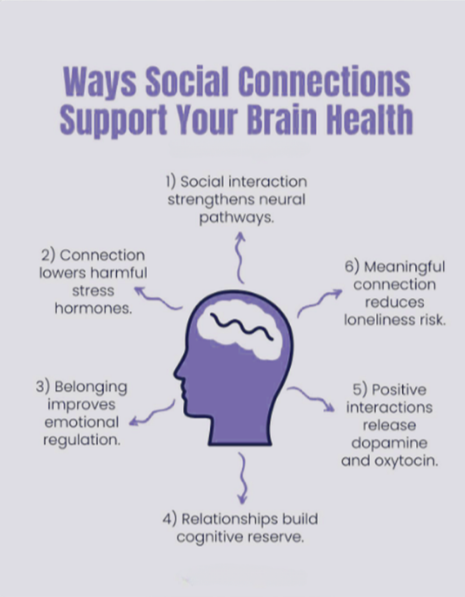
Why Connection Matters More Than We Realize
Here are six ways social connection supports the brain:
- Strengthens neural pathways by activating memory, attention, language, and emotional regulation.
- Reduces stress hormones that can harm cognitive function over time.
- Improves emotional balance and resilience.
- Builds cognitive reserve that helps maintain mental sharpness with age.
- Releases dopamine and oxytocin, boosting motivation and well-being.
- Reduces loneliness, which is linked to better long-term brain health.
Small Moments Count
Connection doesn’t always require big social events or long conversations. A quick chat, a shared meal, or a simple message can still activate the brain in meaningful ways. Even small moments of connection can support brain health, reminding us that relationships are not just part of life, but a vital part of how our brains thrive.
-Julie "Brain Lady" Anderson